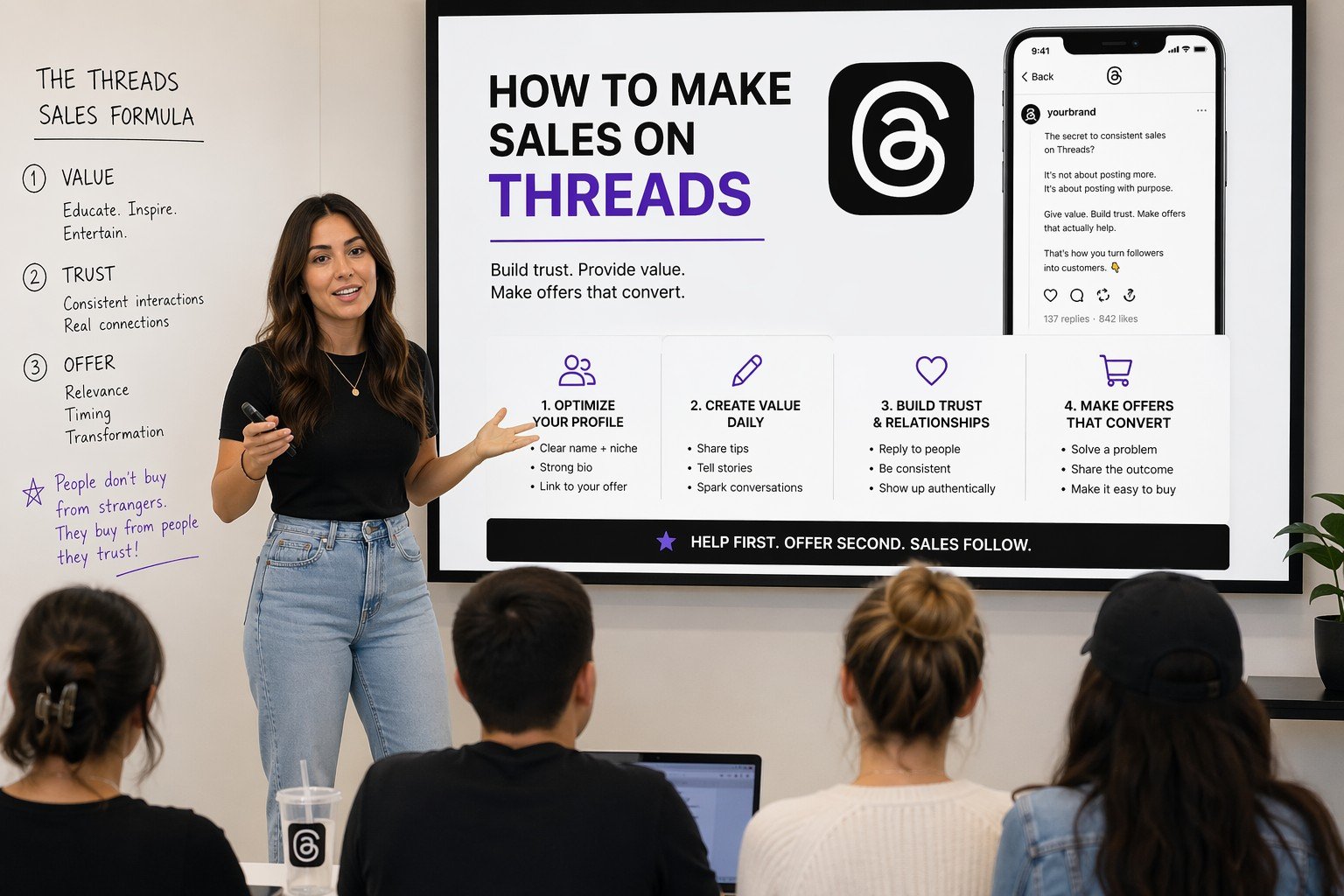
The most common thing I hear from business owners who are active on Threads is some version of this: "I'm posting, I'm getting engagement, people seem to like me, but nobody's actually buying anything." Threads has a reputation for being a content platform, not a sales platform. That reputation is half right. The sale doesn't usually happen on Threads. The sale happens because of Threads.
Threads hit 400 million monthly active users and 141.5 million daily active users by January 2026, and in the same month it surpassed X in mobile usage. Only about 12 percent of marketers are actively using the platform. That means the window for business owners to build an authority position and a real pipeline on Threads is open right now, and it will not stay open forever.
This is a practical guide to how business owners actually make sales on Threads in 2026. What to post, where the buying decision really gets made, the conversion mistakes that quietly kill your growth, and the five-stage path that turns a casual follower into a paying client.
Why Threads Is Actually a Sales Platform (Even Though It Does Not Feel Like One)
Threads is built for conversation, not for clicks. That is a feature, not a bug. The platform lightly deprioritizes posts with external links, which means direct "link in bio" sales posts reach fewer people than substantive content. Most business owners read that as "Threads cannot drive sales." The business owners who are actually making money on Threads read it as "Threads rewards content that builds trust, and trust is what closes sales."
Here is how buying behavior works on Threads. Someone sees one of your posts. They like the way you think. They click your profile. They read your last five or ten posts. If your POV feels sharp and useful and consistent, they follow you. A few weeks later, they see a post from you that mentions something they need. They click the link in your bio or send you a DM on Instagram. Then they book a call or buy.
The sale takes longer on Threads than it might on a landing page funnel. But the conversion rate is significantly higher because the trust is already built by the time they ask about your offer. A Threads follower is a pre-qualified buyer in a way a cold lead from an ad almost never is.
The Real Reason Most Business Owners Do Not Make Sales on Threads
The biggest mistake I see: treating Threads like a billboard instead of a conversation. Posts that say "link in bio for my new course" with no context around them feel like ads, and both the algorithm and your audience treat them that way. Overt selling consistently underperforms soft positioning on this platform in 2026.
The second biggest mistake: not having a clear path from Threads to a sale. If someone reads your posts and wants to work with you, what is supposed to happen next? If the answer is "I guess they would DM me on Instagram?" you do not have a path. You have a hope. Hope does not convert.
The third mistake is being visible but not valuable. Posting every day is not the same as posting well. Business owners who make sales on Threads share a specific kind of content: content that sounds like a real person with a real point of view doing real work. Generic motivational posts, jargon-heavy takes, and reworded Instagram captions all underperform.
The Threads Sales Path: 5 Stages From Post to Purchase
Every sale I have watched happen from Threads for a client follows roughly the same five-stage path. Treat this as your actual funnel.
Stage 1: The post gets noticed. Someone sees your post in their For You feed because it hit the algorithm's engagement thresholds in the first 30 to 90 minutes. The post needs to be specific enough to stop the scroll and substantive enough to earn a reply, a like, or a reshare. (If you want a deeper look at how the Threads algorithm ranks content in 2026, I covered that in How the Threads Algorithm Works for Business Owners.)
Stage 2: The profile visit. If the post lands, they click your name. Your bio, your last ten posts, and your profile header all have to tell a coherent story in about 15 seconds. This is where most business owners lose the sale. Your bio is the single highest-leverage piece of copy on your Threads account. It has to name who you help, what you help them do, and where to go next in one scannable line. If someone has to guess what you offer, you have already lost them. I have broken down the exact formula in How to Write a Threads Bio That Converts, and if you only fix one piece of your Threads presence this month, that is the one.
Stage 3: The follow. They follow you because your POV is clear and your content is useful. This is the trust phase. For the next few weeks or months they see your posts, your replies, your perspective on things happening in your niche. They are quietly evaluating whether you do the work you say you do.
Stage 4: The intent signal. Eventually they see a post from you that hits a problem they have right now. They click your bio link, send you an Instagram DM, reply to your post with a question, or email you. This is your buying signal. They have moved from audience to lead.
Stage 5: The sale. The actual conversion usually happens off-platform. A sales page they read. A discovery call they book. A checkout link in your email. Threads did not close the sale. Threads built the relationship that made the sale possible.
If your Threads strategy skips any of these stages, your conversion rate suffers. Most business owners skip stage 2 (they are inconsistent) or stage 4 (they have no clear place for people to signal intent).
The 4 Types of Posts That Actually Convert on Threads
A healthy Threads feed that produces sales uses four content types in rough proportion: 40 percent authority, 30 percent connection, 20 percent visibility, 10 percent conversion. I have covered this framework in more detail in my guide on what to post on Threads, but here is how each one contributes to sales.
Authority content makes people respect you. Counterintuitive takes from your niche, specific client observations, process breakdowns, industry myths you are calling out. This is what makes someone follow you in the first place.
Connection content makes people trust you. Behind-the-scenes moments, lessons you learned the hard way, personal observations that connect back to your work. This is what makes a follower comfortable enough to buy from you.
Visibility content gets new people in the door. Broad questions, timely takes, relatable observations. This is what keeps your audience growing so you have more potential buyers in the pipeline.
Conversion content is the 10 percent that actually mentions your offer. Too much and your account stops growing. None and you never convert the audience you have built. The trick is making it feel like a natural extension of your authority content, not a sales pitch bolted on.
The Conversion Content Formula: What to Post in the 10 Percent That Drives Revenue
Four post formats make up the conversion content that actually produces sales for business owners on Threads.
The quiet offer mention
An authority post that ends with a single line about your offer. "This is what I do with clients inside Threads Monthly Management. Link in my bio if you want the strategy done for you." One sentence. No pressure. People who are ready will click.
The direct invitation
Every few weeks, post something explicitly direct. "I am opening three spots for Threads Monthly Management in June. If you have been thinking about this, now is the window." Clear. Specific. Not apologetic. Direct invitations convert well when the rest of your feed has earned the right to make one.
The offer story
Tell the story of why your offer exists. What problem you kept seeing. Why the existing options were not solving it. What you built instead. Offer stories are conversion content that does not feel like selling because you are explaining a point of view, not pitching.
The specific client result
A post quoting a client outcome with real context. "One of my clients this month went from 12K monthly Pinterest impressions to 49K after we restructured her board strategy. Here is exactly what changed." Specific, grounded, and doubling as authority content. (If you want to see how I think about the traffic side of that equation, my breakdown of Pinterest + Threads as a combined traffic system walks through why these two platforms compound when used together.)
Notice what is missing from that list: "Only 3 spots left!!!" urgency posts, generic testimonial screenshots, and anything that reads like a paid ad. Those all underperform on Threads in 2026.
Where the Sale Actually Gets Made (Hint: Not in Your Post)
This is the piece most business owners miss. The sale from a Threads follower almost always closes somewhere else. Your job is to design that somewhere-else carefully.
Your bio link is the highest-converting CTA on Threads. Not because people click it often, but because the people who do click it are already sold. Make sure it points to your highest-intent page: a services page, a discovery call booking link, or a lead magnet that starts a nurture sequence.
Your Instagram DMs are where actual sales conversations happen, at least until Threads DMs roll out fully across all regions and desktop. If your Instagram is connected to your Threads, treat every Instagram DM from a Threads follower like a sales call in progress. Respond within 24 hours. Be specific. Ask questions before you pitch.
Your email list is the long-game conversion engine. A lead magnet in your Threads bio that captures email addresses is the single highest-ROI move I see Threads-active business owners make. Followers are not customers. Email subscribers are customers in waiting.
Threads Sales Mistakes That Quietly Kill Your Conversion Rate
A few patterns slow conversion for business owners even when the content looks fine on the surface.
Posting sales content without the authority content to support it. If your last ten posts are all offers, the 11th one will not convert either. Conversion content rides on the back of authority content. Build the trust first.
Using Threads as a pure traffic play. Threads does not reward posts that exist mostly to send people somewhere else. Posts with links reach 30 to 50 percent fewer people than posts without. Lead with the value in the post itself. Save the link for the bio or for a reply.
Treating Threads like a broadcast. Accounts that post and never reply grow slower than accounts that post less and reply more. A thoughtful reply to another business owner's post is often a better sales move than your own post. Relationships on Threads close deals.
Inconsistent posting. The Threads algorithm heavily favors recency and engagement momentum. An account that posts five times in a week then goes quiet for three loses its reach. Three to five posts a week, every week, beats ten posts followed by silence.
Selling before you have earned the right. If you have not posted in three months and your first post back is a sales pitch, your audience will feel it. Warm the room first. Then make the offer.
The 30-Day Threads Sales Plan for Business Owners
If you are starting from scratch or restarting a dormant Threads presence, this is a simple structure that works.
- Week 1: Position. Post daily. All authority and connection content. Your POV, your perspective, your process. No offers. Build a baseline of trust.
- Week 2: Visibility. Continue authority and connection. Add two visibility posts (broad questions, timely takes) to expand reach. Still no offers. Start replying to at least three other business owners' posts each day.
- Week 3: Introduce the offer. Add one quiet offer mention. Just one. At the end of an authority post that is genuinely useful. See what happens. Keep the rest of the feed on authority and connection.
- Week 4: Direct invitation. If the first offer mention landed, post a direct invitation this week. Clear, specific, not apologetic. Watch the bio link clicks. Respond to any DMs immediately.
By the end of 30 days you will have a baseline for what is working. From there, the rhythm is roughly two authority posts, one connection post, one visibility post, and one conversion post every two weeks, plus three to five thoughtful replies per week. That is the sustainable pattern that produces sales from Threads for most business owners.
Frequently Asked Questions
How long does it take to make sales from Threads?
For most business owners with an existing audience, the first sales from Threads take 30 to 90 days of consistent posting. For accounts starting from zero, the first sales usually come around month three or four. The platform rewards consistency more than frequency, and trust compounds over time. Accounts that post for two weeks and stop almost never see sales.
Should I include links in my sales posts on Threads?
Sparingly. Posts with external links reach 30 to 50 percent fewer people than posts without. A better approach is to lead with the value in the post, end with a line like "link in my bio if you want the full system," and drive traffic through your bio link instead. Some business owners also drop the link in a reply to their own post rather than in the post itself.
How often should I post sales content on Threads?
Keep conversion content at around 10 percent of your total posting. That works out to one conversion post roughly every two weeks if you are posting three to five times per week. Mix in offer stories, direct invitations, specific client results, and quiet offer mentions. Overweighting conversion content kills reach fast.
Do Threads DMs work for sales conversations?
Threads DMs are currently available only on mobile and only in certain regions, and there is no desktop functionality yet. For most business owners in 2026, sales conversations with Threads followers still happen on Instagram or over email. Make sure your Instagram DMs are open and that your bio link leads somewhere a motivated buyer can take action.
Should I run Threads ads instead of posting organically?
Threads ads opened globally in 2026 and work with standard Meta ad objectives including Sales, Leads, and Traffic. Ads can accelerate reach but will not replace the trust that organic content builds. The highest-converting strategy is usually organic-first: build an audience with consistent content, then amplify your best-performing posts or specific offers with ads once you know what resonates.
Can I make sales on Threads without being salesy?
Yes. In fact, the business owners making the most sales on Threads in 2026 are the ones who rarely sound salesy. Authority content, specific client observations, and a clear POV do more of the selling than overt pitches ever will. The sale happens because someone has spent weeks watching you think out loud and decided they want to work with whoever thinks like that.
The Bottom Line on Selling on Threads
Threads is not a direct-response sales platform. It is a trust-building platform that produces sales for business owners who understand how the buying journey actually works on it. The sale does not close inside the app. It closes in a DM, a booking link, an email, or a checkout page that someone found because your Threads content earned their attention first.
The business owners who make sales on Threads in 2026 are the ones treating it like a long game. They post consistently, reply often, share a clear point of view, and resist the urge to pitch every third post. Do that for 90 days and the pipeline starts filling itself.
Want help turning your Threads presence into a sales pipeline?
Threads Monthly Management builds and runs your entire strategy so you show up consistently, in your voice, with content engineered to attract buyers, not just followers. Everything from posting to replies to conversion content, done for you.
See Threads Management